
Looking for reliable CNC Swiss Machining Brass? VT machining manufactures Brass parts to tight tolerances and consistent quality. Brass is free-machining, good conductivity, attractive finish, so the process is set up specifically for the material.
Starting Parameters for CNC Swiss Machining Brass
| Cutting speed (carbide) | 290-575 m/min |
|---|---|
| Feed | 0.1-0.35 mm/rev |
| Spindle speed, Ø8 mm bar | 11540-22880 rpm |
| Insert / tool class | ISO N — sharp, polished, uncoated or DLC |
| Coolant | Dry or light emulsion; zero-rake tools to prevent grabbing |
| Length-to-diameter capability | up to ~20:1 |
Shown for C360 Brass, the most common Brass grade we see for CNC Swiss Machining. Starting values for C360 Brass, Half-hard; optimised on the first article.
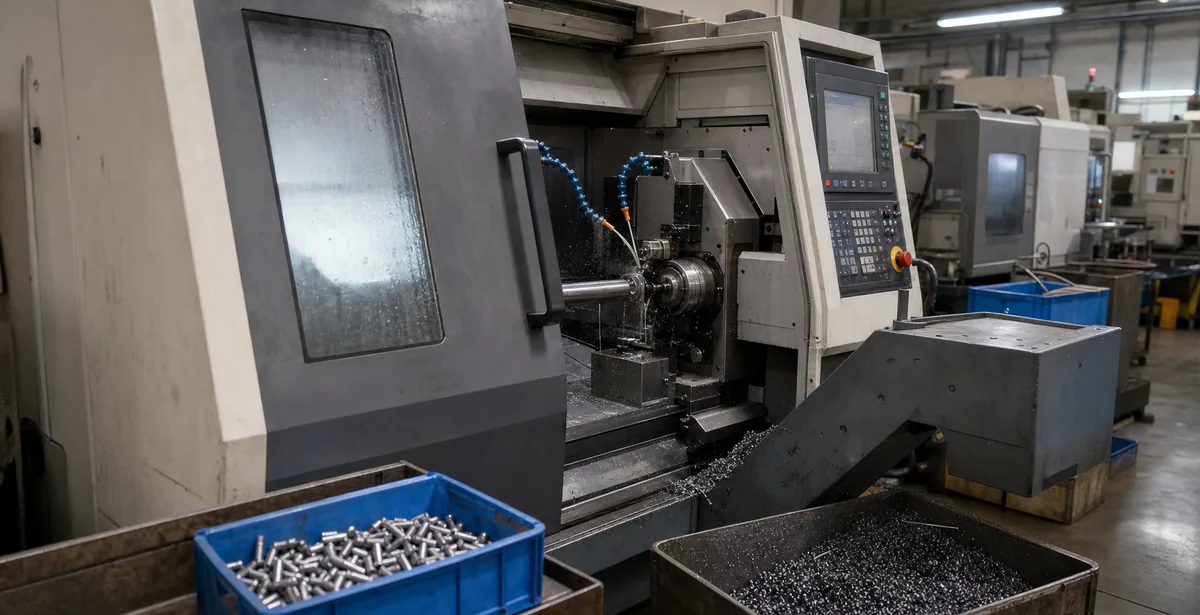
CNC Swiss Machining Capability for Brass
- Ø1–32 mm bar
- Slenderness without deflection
- Tolerance to ±0.003 mm
- High-volume small parts
Brass material properties, finishing options and grade notes are on our CNC Turning Brass page.
How CNC Swiss Machining Brass Works
The Brass bar or billet rotates in the spindle while single-point tools shape outer diameters, bores, faces, grooves and threads. Constant surface speed control keeps cutting conditions stable from large to small diameters.
Every job begins from your CAD model or 2D drawing. Fixturing and tool paths are planned so the most critical dimensions are produced in the most rigid, repeatable setup. Critical dimensions are checked on the first part and monitored through the run.
Achievable Tolerances for CNC Swiss Machining Brass
| Feature | Standard | Precision |
|---|---|---|
| Outside diameter | ±0.05 mm | ±0.005 mm |
| Bore diameter | H9 | H6 |
| Length / shoulder position | ±0.10 mm | ±0.020 mm |
| Concentricity OD to ID | 0.05 mm TIR | 0.010 mm TIR |
| Roundness | 0.02 mm | 0.005 mm |
| Thread class | 6g / 2A | 4h / 3A |
| Surface finish, as turned | Ra 1.6 µm | Ra 0.4 µm |
Standard is what a normal quotation assumes. Precision is available on nominated features and is priced separately, because it needs extra setups, in-process gauging and CMM verification. Call out only the features that need it — blanket-tightening a drawing is the single most common reason a quote comes back expensive.
Design Tips for CNC Swiss Machining Brass
A few design choices make a real difference to cost and quality. Consistent diameters, standard thread forms and avoiding extremely long, slender features help Brass turned parts stay concentric and economical. If you send your model early, we will return practical DFM feedback before you commit to production.
CNC Swiss Machining Tolerances & Surface Finish
Turned Brass holds diameter tolerances to about ±0.005 mm with concentricity within 0.01 mm and good roundness. Turned finishes of Ra 0.4–0.8 µm are achievable with finishing passes and sharp tooling.
Final tolerances are governed by the material's behaviour, wall thickness and overall stiffness. We give honest DFM feedback if a callout would be costly or better achieved another way.
Applications of CNC Swiss Machining Brass
CNC Swiss Machining of Brass supports parts across aerospace, medical, automotive, electronics, semiconductor, energy and general industrial sectors. We scale from one-off prototypes to ongoing production while holding the same quality.
Typical Brass Parts for CNC Swiss Machining
Illustrative examples of CNC Swiss Machining Brass parts and the callouts that usually drive the process plan. They show the kind of work that fits this process; they are not specific customer orders.
Valve seat
- Material
- Brass
- Size
- Ø28 × 14 mm
- Key callouts
- Seat angle 45° ±0.1°, roundness 0.005 mm, Ra 0.2 µm
- Batch
- 800 pcs
Seat finished with a single-point diamond pass, no interruption.
Precision shaft
- Material
- Brass
- Size
- Ø16 × 240 mm
- Key callouts
- OD h6, concentricity 0.01 mm TIR, keyway 5 H9
- Batch
- 1,000 pcs / year
Turned between centres so both journals share one datum.
Threaded fitting
- Material
- Brass
- Size
- Ø22 hex × 38 mm
- Key callouts
- G3/8" thread class 4h, bore H8, sealing face Ra 0.8 µm
- Batch
- 2,500 pcs
Run on a sub-spindle lathe so the back face is finished without a second setup.
No drawing yet? Build one in the browser.
Set the metal, dimensions and features, watch the 3D model update as you type, then switch to the 2D sheet to add dimensions and tolerances. Download it or send it straight to us with your RFQ.
What We Need to Quote CNC Swiss Machining Brass
- GeometrySTEP or IGES for the 3D model, plus a PDF drawing if you have tolerance callouts. A dimensioned sketch is enough to start.
- MaterialThe exact Brass grade and condition — temper, heat-treat state or hardness. If you are not sure, tell us the function and we will suggest one.
- QuantityPrototype count and the expected annual volume. Both change how the part is made and therefore what it costs.
- TolerancesWhich features are critical. Everything else runs to our standard tolerance, which is what keeps the price sensible.
- FinishSurface treatment, cosmetic requirements, and any faces that must be masked.
- DocumentsWhether you need a material certificate, dimensional report, FAIR or PPAP with the shipment.
Missing something from the list is not a problem — send what you have. We will come back with the specific questions rather than a generic form.
Other Metals for CNC Swiss Machining
Other Processes for Brass
Send the drawing, the Brass grade and the quantity. You get pricing, lead time and any DFM notes back — usually within one business day.
Request a QuoteFrequently Asked Questions
Does CNC Swiss Machining Brass require dedicated tooling?
Most Brass turning work uses standard cutting tools and CNC programs; dedicated fixtures are made only when geometry or volume requires them.
Why is Brass a good choice for CNC Swiss Machining?
Brass is free-machining, good conductivity, attractive finish, which makes it well suited to CNC Swiss Machining. We tune the process to the alloy so the finished Brass turning part meets your dimensional and functional requirements.
What material thickness or size range suits CNC Swiss Machining Brass?
Turned Brass parts are produced from bar or chuck stock across a wide diameter range.
Can VT machining make custom Brass parts to my drawing?
Yes. Brass turning is made to order from your CAD/2D drawing. Share your geometry, material grade, tolerance and quantity and we will confirm feasibility, lead time and pricing.
What is CNC Swiss Machining Brass and how is it done?
CNC Swiss Machining Brass refers to swiss-type machining guides bar stock through a sliding headstock for high-accuracy small, slender parts. Applied to Brass — free-machining, good conductivity, attractive finish — VT machining produces each part to your CAD drawing, selecting parameters from your tolerance, finish and quantity requirements.
What is the typical lead time and minimum order for CNC Swiss Machining Brass?
CNC Swiss Machining prototypes for Brass can be produced quickly and scaled to series production. Send your drawing and quantity and we will advise lead time and any minimum order.