CNC EDM Drilling Steel is a core capability at VT machining. We combine controlled EDM machining with material-aware setup for Steel — an alloy that is strong, economical, widely available carbon/alloy grades — to produce parts that meet your specification first time.
Process Data for CNC EDM Drilling Steel
| Hole diameter range | Ø0.3-3.0 mm |
|---|---|
| Max depth-to-diameter | up to ~100:1 |
| Drilling speed, Ø1 mm | ~25 mm/min |
Shown for 1018 Steel, the most common Steel grade we see for CNC EDM Drilling. Typical values for 1018 Steel, Cold-drawn; confirmed on the first part.
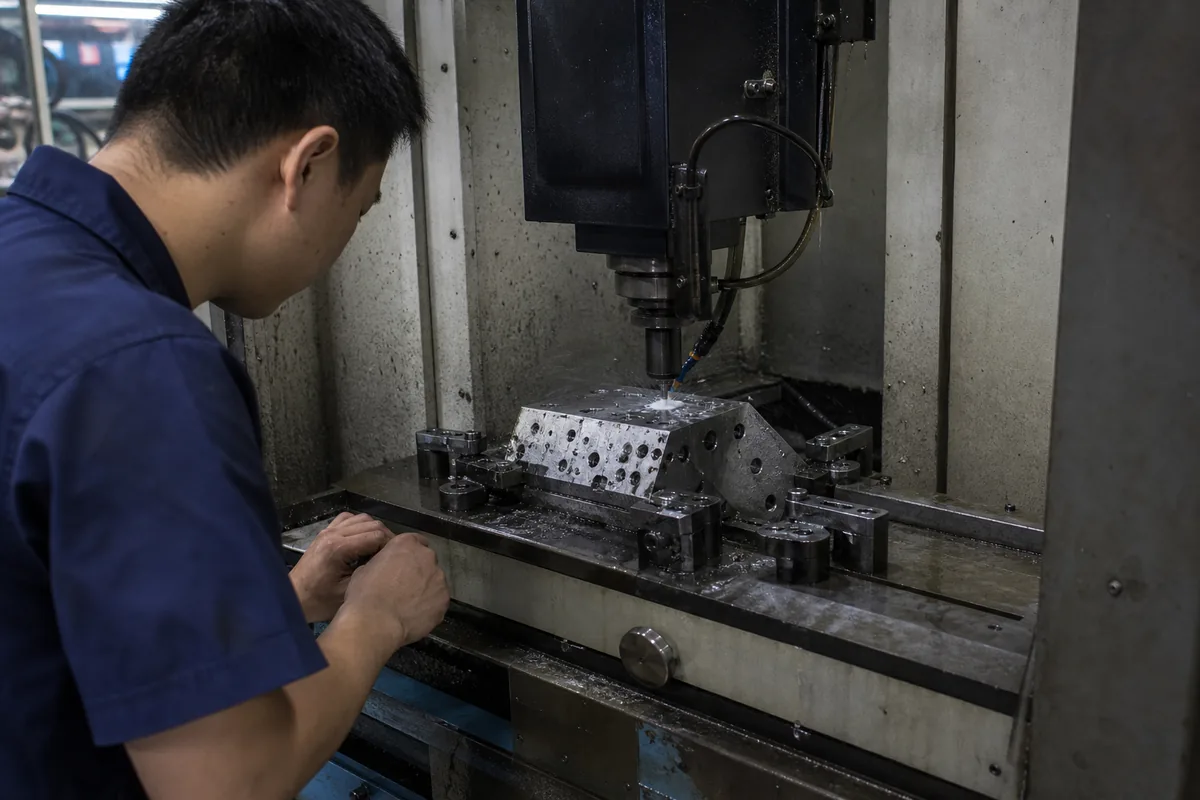
CNC EDM Drilling Capability for Steel
- Ø0.2–3 mm holes
- Deep aspect ratios
- Hardened-metal drilling
- Angled hole capability
Steel material properties, finishing options and grade notes are on our CNC Wire EDM Steel page.
How CNC EDM Drilling Steel Works
Material is removed from the Steel workpiece by controlled electrical discharges across a dielectric gap, with no mechanical contact. Flushing, on/off pulse timing and electrode/wire feed are set to balance speed against surface finish.
We start from your supplied geometry and tolerance scheme. The setup is designed to minimise re-clamping, which protects positional accuracy across features. A first article is verified against the drawing before the balance of the batch is released.
Achievable Tolerances for CNC EDM Drilling Steel
| Feature | Standard | Precision |
|---|---|---|
| Profile dimension | ±0.010 mm | ±0.002 mm |
| Internal corner radius | 0.15 mm | 0.05 mm |
| Taper control over 50 mm | 0.02 mm | 0.005 mm |
| Surface finish (skim passes) | Ra 0.8 µm | Ra 0.2 µm |
| Recast layer | 10 µm | 2 µm (fine skim) |
| Start-hole diameter | 1.0 mm | 0.25 mm |
| Workpiece hardness | no limit (conductive) | no limit (conductive) |
Standard is what a normal quotation assumes. Precision is available on nominated features and is priced separately, because it needs extra setups, in-process gauging and CMM verification. Call out only the features that need it — blanket-tightening a drawing is the single most common reason a quote comes back expensive.
CNC EDM Drilling Tolerances & Surface Finish
EDM holds tolerances to roughly ±0.002–0.005 mm with no cutting force on the Steel part, producing fine, controlled surface textures and sharp internal corners impossible to mill.
The tightest tolerances are reserved for the features your drawing flags as critical. Share your tolerance scheme and we will confirm what is realistic before quoting.
Design Tips for CNC EDM Drilling Steel
Small design adjustments often cut cost and lead time. EDM suits sharp internal corners, thin ribs and hardened Steel that cannot be milled; allowing a small corner radius where possible speeds the cut. If you send your model early, we will return practical DFM feedback before you commit to production.
Applications of CNC EDM Drilling Steel
Steel parts made this way are found throughout aerospace, medical, automotive, electronics and industrial equipment. Prototype, bridge and production volumes are all welcome.
Typical Steel Parts for CNC EDM Drilling
Illustrative examples of CNC EDM Drilling Steel parts and the callouts that usually drive the process plan. They show the kind of work that fits this process; they are not specific customer orders.
Carbide punch
- Material
- Steel
- Size
- Ø6 × 45 mm
- Key callouts
- OD ±0.003 mm, sharp form retained
- Batch
- 250 pcs
Carbide is EDM or grind only; there is no milling route.
Micro slot in nozzle
- Material
- Steel
- Size
- 0.15 mm wide × 6 mm deep
- Key callouts
- Width ±0.003 mm
- Batch
- 400 pcs
Cut with 0.1 mm wire; the start hole is EDM-drilled at Ø0.3 mm.
Turbine blade fir-tree root
- Material
- Steel
- Size
- 40 × 25 mm section
- Key callouts
- Profile ±0.008 mm
- Batch
- 120 pcs
Held on a dedicated fixture so every blade in the set indexes identically.
No drawing yet? Build one in the browser.
Set the metal, dimensions and features, watch the 3D model update as you type, then switch to the 2D sheet to add dimensions and tolerances. Download it or send it straight to us with your RFQ.
What We Need to Quote CNC EDM Drilling Steel
- GeometrySTEP or IGES for the 3D model, plus a PDF drawing if you have tolerance callouts. A dimensioned sketch is enough to start.
- MaterialThe exact Steel grade and condition — temper, heat-treat state or hardness. If you are not sure, tell us the function and we will suggest one.
- QuantityPrototype count and the expected annual volume. Both change how the part is made and therefore what it costs.
- TolerancesWhich features are critical. Everything else runs to our standard tolerance, which is what keeps the price sensible.
- FinishSurface treatment, cosmetic requirements, and any faces that must be masked.
- DocumentsWhether you need a material certificate, dimensional report, FAIR or PPAP with the shipment.
Missing something from the list is not a problem — send what you have. We will come back with the specific questions rather than a generic form.
Other Metals for CNC EDM Drilling
Other Processes for Steel
Send the drawing, the Steel grade and the quantity. You get pricing, lead time and any DFM notes back — usually within one business day.
Request a QuoteFrequently Asked Questions
What material thickness or size range suits CNC EDM Drilling Steel?
We machine Steel across a broad size range; share your part envelope for confirmation.
Does CNC EDM Drilling Steel require dedicated tooling?
Wire EDM needs no shaped tooling; sinker EDM uses a shaped electrode we produce in-house for your cavity.
What surface finish is achievable on Steel with CNC EDM Drilling?
Surface finish on Steel is controlled to your specification; we confirm the achievable Ra against your callout.
What tolerances can you hold for CNC EDM Drilling Steel?
Achievable tolerances for Steel EDM machining depend on the alloy, geometry and feature size. EDM holds tolerances to around ±0.002 mm with no cutting force on the part. Exact figures are confirmed against your drawing callouts.