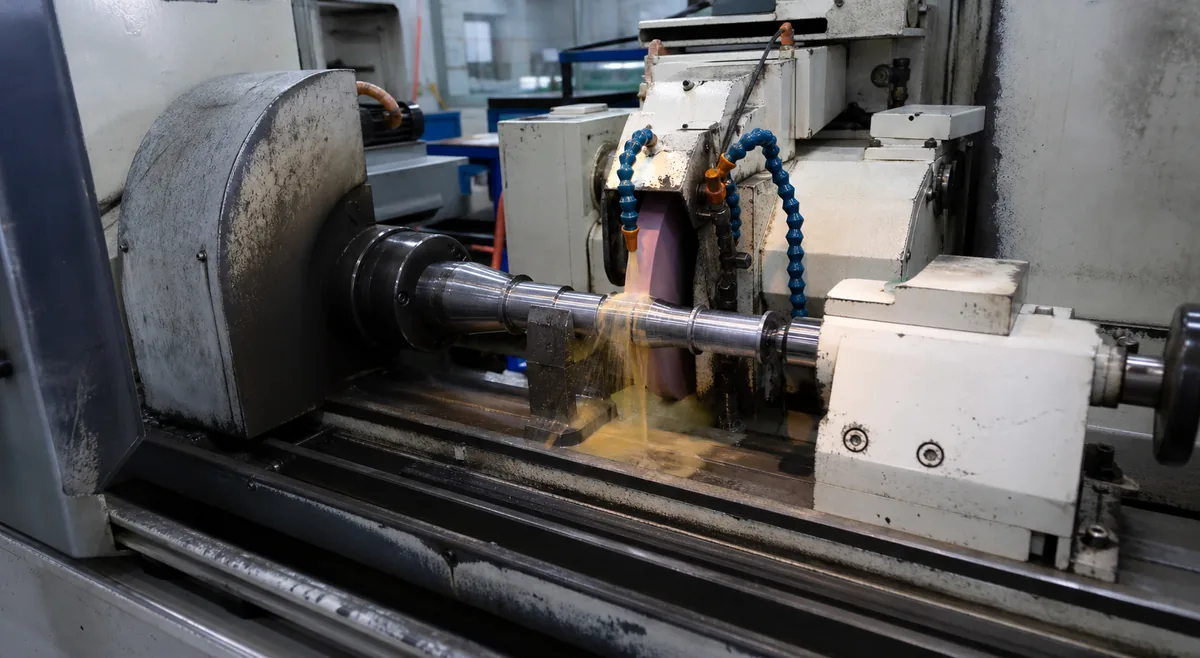
CNC Cylindrical Grinding Steel is a core capability at VT machining. We combine controlled grinding with material-aware setup for Steel — an alloy that is strong, economical, widely available carbon/alloy grades — to produce parts that meet your specification first time.
CNC Cylindrical Grinding Capability for Steel
- Roundness within 0.002 mm
- OD tolerance ±0.002 mm
- Ra to 0.2 µm
- Between-centers work
Steel Material Data
| Density | 7.85 g/cm³ |
|---|---|
| Tensile strength | 585 MPa |
| Yield strength (0.2%) | 450 MPa |
| Hardness | 170 HB |
| Melting point | 1420–1460 °C |
| Thermal conductivity | 51.9 W/m·K |
| Thermal expansion | 11.5 ×10⁻⁶/K |
| Electrical conductivity | 9% |
| Machinability (C36000 = 100%) | 57% |
| Grades we run | 1018, 1045, 1215, A36, S45C, St37, 4140 (see alloy steel) |
Published typical values for 1045. Other grades in the family differ — the certificate supplied with your order carries the actual heat-lot figures.
Rust. Bare steel flash-rusts within hours in a humid container, so parts are oiled or passivated before packing unless you specify otherwise.
How CNC Cylindrical Grinding Steel Works
An abrasive wheel removes a fine, controlled layer from the Steel part. Wheel specification, dressing interval, infeed and coolant are matched to the alloy's hardness so the surface is not burned or left with residual stress.
We start from your supplied geometry and tolerance scheme. The setup is designed to minimise re-clamping, which protects positional accuracy across features. A first article is verified against the drawing before the balance of the batch is released.
Achievable Tolerances for CNC Cylindrical Grinding Steel
| Feature | Standard | Precision |
|---|---|---|
| Size (OD, ID, thickness) | ±0.005 mm | ±0.002 mm |
| Flatness over 100 mm | 0.010 mm | 0.003 mm |
| Parallelism | 0.010 mm | 0.003 mm |
| Roundness | 0.005 mm | 0.002 mm |
| Squareness | 0.010 mm | 0.005 mm |
| Surface finish | Ra 0.4 µm | Ra 0.1 µm |
| Workpiece hardness | up to 62 HRC | up to 65 HRC |
Standard is what a normal quotation assumes. Precision is available on nominated features and is priced separately, because it needs extra setups, in-process gauging and CMM verification. Call out only the features that need it — blanket-tightening a drawing is the single most common reason a quote comes back expensive.
CNC Cylindrical Grinding Quality & Inspection
Quality is built in, not inspected on. We monitor key features during the run and confirm them at final inspection, with CMM verification available for tight tolerances. We provide the inspection and traceability records your quality system requires.
Working with Steel
Steel is strong, economical, widely available carbon/alloy grades. We translate those properties into a process plan: the right tooling, speeds, feeds and fixturing for the alloy.
Where the grade, temper or heat-treat condition matters to performance, we confirm it with you and can supply material certificates. Material is procured to recognised standards for consistent, repeatable results.
Secondary Operations & Finishing
Most Steel parts need some finishing, which we manage in-house or through vetted partners. Options include deburring and edge-breaking, heat treatment, surface grinding, polishing, and plating or anodising for corrosion resistance and appearance. Give us the finished-part requirement and we will sequence every operation correctly.
CNC Cylindrical Grinding Tolerances & Surface Finish
Ground Steel reaches single-micron tolerances on size, flatness and parallelism, with surface finishes down to Ra 0.1–0.4 µm — and a near-mirror finish on suitable alloys.
The tightest tolerances are reserved for the features your drawing flags as critical. Share your tolerance scheme and we will confirm what is realistic before quoting.
Design Tips for CNC Cylindrical Grinding Steel
Small design adjustments often cut cost and lead time. Allowing adequate grind stock, specifying realistic flatness over the true datum, and relieving corners help us hit tight tolerances on Steel efficiently. If you send your model early, we will return practical DFM feedback before you commit to production.
Applications of CNC Cylindrical Grinding Steel
Steel parts made this way are found throughout aerospace, medical, automotive, electronics and industrial equipment. Prototype, bridge and production volumes are all welcome.
How to Order CNC Cylindrical Grinding Steel
Starting your project takes one email. Send your CAD or 2D drawing, the Steel grade and condition, the quantity and any finish or inspection requirements. We respond quickly with price, lead time and any DFM notes, in clear English.
Parts We Have Run in Steel
Three representative CNC Cylindrical Grinding Steel jobs, with the callouts that actually drove the process plan. Yours will differ — these are here so you can judge whether your part is in our range before you spend time on an RFQ.
Slitter blade
- Material
- Steel
- Size
- Ø150 × 1.5 mm
- Key callouts
- Thickness ±0.005 mm, edge concentricity 0.005 mm
- Batch
- 400 pcs
Ground in a stack so all blades in a set share the same thickness.
Gauge block set
- Material
- Steel
- Size
- 50 × 30 × 10 mm
- Key callouts
- Thickness ±0.002 mm, flatness 0.002 mm, parallelism 0.002 mm
- Batch
- 200 pcs
Ground wet in one chucking, then left to normalise before final inspection at 20 °C.
Punch tool
- Material
- Steel
- Size
- Ø10 × 60 mm
- Key callouts
- OD ±0.002 mm, roundness 0.002 mm, Ra 0.1 µm
- Batch
- 300 pcs
Cylindrical ground after hardening to 60 HRC — machining soft would not hold the size.
Finishing Options for Steel
| Finish | Thickness / effect | Why it gets specified |
|---|---|---|
| Black oxide | 1–2 µm | Mild corrosion resistance, no dimensional change |
| Zinc plate + clear/yellow | 5–12 µm | ASTM B633, general corrosion protection |
| Nickel plate (electroless) | 10–25 µm | Uniform in bores, 500 HV after bake |
| Phosphate | 5–10 µm | Paint key, mild lubricity |
| Powder coat | 60–120 µm | RAL colours |
| Deburr / edge break | 0.05–0.3 mm | All parts unless the drawing says otherwise |
| Bead blast | Ra 1.6–3.2 µm | Uniform matt finish, hides tool marks |
| Laser marking | — | Part number, lot code, data matrix |
No drawing yet? Build one in the browser.
Set the metal, dimensions and features, watch the 3D model update as you type, then switch to the 2D sheet to add dimensions and tolerances. Download it or send it straight to us with your RFQ.
What We Need to Quote CNC Cylindrical Grinding Steel
- GeometrySTEP or IGES for the 3D model, plus a PDF drawing if you have tolerance callouts. A dimensioned sketch is enough to start.
- MaterialThe exact Steel grade and condition — temper, heat-treat state or hardness. If you are not sure, tell us the function and we will suggest one.
- QuantityPrototype count and the expected annual volume. Both change how the part is made and therefore what it costs.
- TolerancesWhich features are critical. Everything else runs to our standard tolerance, which is what keeps the price sensible.
- FinishSurface treatment, cosmetic requirements, and any faces that must be masked.
- DocumentsWhether you need a material certificate, dimensional report, FAIR or PPAP with the shipment.
Missing something from the list is not a problem — send what you have. We will come back with the specific questions rather than a generic form.
Other Metals for CNC Cylindrical Grinding
Other Processes for Steel
Send the drawing, the Steel grade and the quantity. You get pricing, lead time and any DFM notes back — usually within one business day.
Request a QuoteFrequently Asked Questions
Which industries use CNC Cylindrical Grinding Steel parts?
CNC Cylindrical Grinding Steel parts are used across aerospace, medical, automotive, electronics, semiconductor and general industrial sectors — anywhere precise Steel components are required.
What surface finish is achievable on Steel with CNC Cylindrical Grinding?
Grinding can take Steel to a fine finish — typically Ra 0.1–0.4 µm, and to a mirror grade on suitable alloys.
How clean are the edges produced by CNC Cylindrical Grinding on Steel?
Machined Steel edges are clean and to specification; edge-break or deburring is added when your drawing calls for it.
Can VT machining make custom Steel parts to my drawing?
Yes. Steel Steel grinding is made to order from your CAD/2D drawing. Share your geometry, material grade, tolerance and quantity and we will confirm feasibility, lead time and pricing.