CNC Cylindrical Grinding Alloy Steel is a core capability at VT machining. We combine controlled grinding with material-aware setup for Alloy Steel — an alloy that is high strength and hardenability for demanding parts — to produce parts that meet your specification first time.
Process Data for CNC Cylindrical Grinding Alloy Steel
| Wheel (supply condition) | Aluminium oxide |
|---|---|
| Depth per pass (rough / finish) | 0.01-0.03 / 0.002-0.005 mm |
| Achievable finish | Ra 0.2-0.4 µm |
| Typical size tolerance | Ø ±0.002 mm, roundness 0.001-0.002 mm |
| Diameter growth, Ø50 mm, +3 °C | 1.8 µm |
| Work speed | 15-30 m/min (between centres) |
Shown for 4140 Alloy Steel, the most common Alloy Steel grade we see for CNC Cylindrical Grinding. Typical values for 4140 Alloy Steel, Annealed or pre-hardened (28-32 HRC); confirmed on the first part.
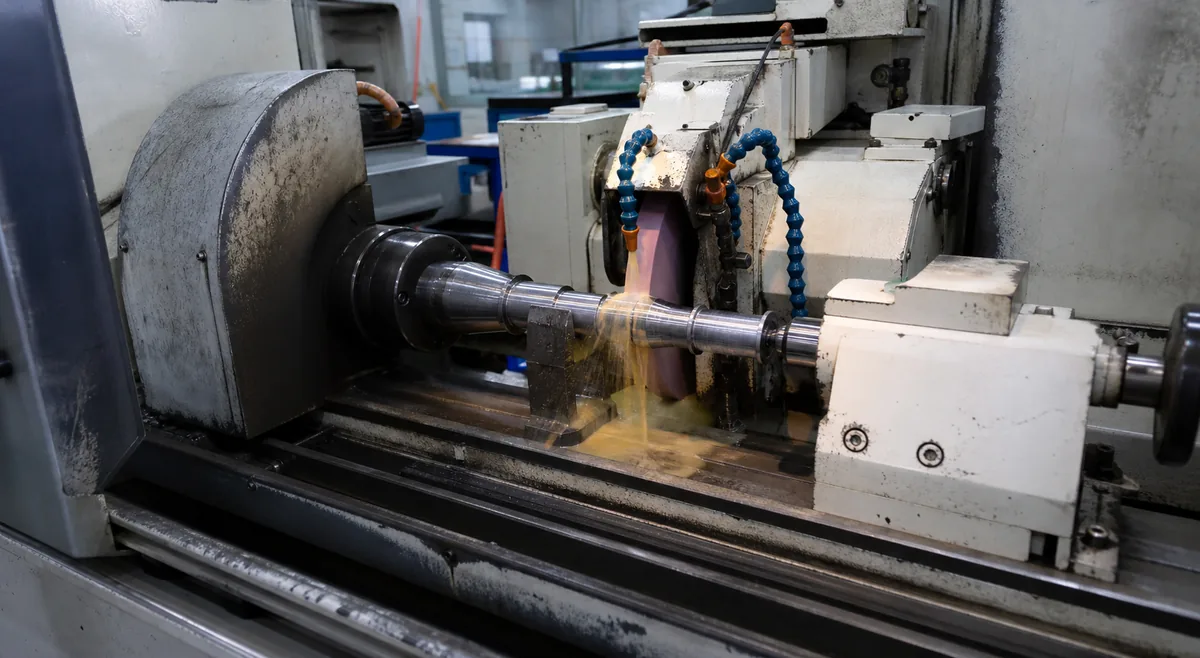
CNC Cylindrical Grinding Capability for Alloy Steel
- Roundness within 0.002 mm
- OD tolerance ±0.002 mm
- Ra to 0.2 µm
- Between-centers work
Alloy Steel material properties, finishing options and grade notes are on our CNC Surface Grinding Alloy Steel page.
How CNC Cylindrical Grinding Alloy Steel Works
An abrasive wheel removes a fine, controlled layer from the Alloy Steel part. Wheel specification, dressing interval, infeed and coolant are matched to the alloy's hardness so the surface is not burned or left with residual stress.
Every job begins from your CAD model or 2D drawing. Fixturing and tool paths are planned so the most critical dimensions are produced in the most rigid, repeatable setup. Critical dimensions are checked on the first part and monitored through the run.
Achievable Tolerances for CNC Cylindrical Grinding Alloy Steel
| Feature | Standard | Precision |
|---|---|---|
| Size (OD, ID, thickness) | ±0.005 mm | ±0.002 mm |
| Flatness over 100 mm | 0.010 mm | 0.003 mm |
| Parallelism | 0.010 mm | 0.003 mm |
| Roundness | 0.005 mm | 0.002 mm |
| Squareness | 0.010 mm | 0.005 mm |
| Surface finish | Ra 0.4 µm | Ra 0.1 µm |
| Workpiece hardness | up to 62 HRC | up to 65 HRC |
Standard is what a normal quotation assumes. Precision is available on nominated features and is priced separately, because it needs extra setups, in-process gauging and CMM verification. Call out only the features that need it — blanket-tightening a drawing is the single most common reason a quote comes back expensive.
Design Tips for CNC Cylindrical Grinding Alloy Steel
A few design choices make a real difference to cost and quality. Allowing adequate grind stock, specifying realistic flatness over the true datum, and relieving corners help us hit tight tolerances on Alloy Steel efficiently. If you send your model early, we will return practical DFM feedback before you commit to production.
CNC Cylindrical Grinding Tolerances & Surface Finish
Ground Alloy Steel reaches single-micron tolerances on size, flatness and parallelism, with surface finishes down to Ra 0.1–0.4 µm — and a near-mirror finish on suitable alloys.
Final tolerances are governed by the material's behaviour, wall thickness and overall stiffness. We give honest DFM feedback if a callout would be costly or better achieved another way.
Applications of CNC Cylindrical Grinding Alloy Steel
CNC Cylindrical Grinding of Alloy Steel supports parts across aerospace, medical, automotive, electronics, semiconductor, energy and general industrial sectors. We scale from one-off prototypes to ongoing production while holding the same quality.
Typical Alloy Steel Parts for CNC Cylindrical Grinding
Illustrative examples of CNC Cylindrical Grinding Alloy Steel parts and the callouts that usually drive the process plan. They show the kind of work that fits this process; they are not specific customer orders.
Slitter blade
- Material
- Alloy Steel
- Size
- Ø150 × 1.5 mm
- Key callouts
- Thickness ±0.005 mm, edge concentricity 0.005 mm
- Batch
- 400 pcs
Ground in a stack so all blades in a set share the same thickness.
Gauge block set
- Material
- Alloy Steel
- Size
- 50 × 30 × 10 mm
- Key callouts
- Thickness ±0.002 mm, flatness 0.002 mm, parallelism 0.002 mm
- Batch
- 200 pcs
Ground wet in one chucking, then left to normalise before final inspection at 20 °C.
Punch tool
- Material
- Alloy Steel
- Size
- Ø10 × 60 mm
- Key callouts
- OD ±0.002 mm, roundness 0.002 mm, Ra 0.1 µm
- Batch
- 300 pcs
Cylindrical ground after hardening to 60 HRC — machining soft would not hold the size.
No drawing yet? Build one in the browser.
Set the metal, dimensions and features, watch the 3D model update as you type, then switch to the 2D sheet to add dimensions and tolerances. Download it or send it straight to us with your RFQ.
What We Need to Quote CNC Cylindrical Grinding Alloy Steel
- GeometrySTEP or IGES for the 3D model, plus a PDF drawing if you have tolerance callouts. A dimensioned sketch is enough to start.
- MaterialThe exact Alloy Steel grade and condition — temper, heat-treat state or hardness. If you are not sure, tell us the function and we will suggest one.
- QuantityPrototype count and the expected annual volume. Both change how the part is made and therefore what it costs.
- TolerancesWhich features are critical. Everything else runs to our standard tolerance, which is what keeps the price sensible.
- FinishSurface treatment, cosmetic requirements, and any faces that must be masked.
- DocumentsWhether you need a material certificate, dimensional report, FAIR or PPAP with the shipment.
Missing something from the list is not a problem — send what you have. We will come back with the specific questions rather than a generic form.
Other Metals for CNC Cylindrical Grinding
Other Processes for Alloy Steel
Send the drawing, the Alloy Steel grade and the quantity. You get pricing, lead time and any DFM notes back — usually within one business day.
Request a QuoteFrequently Asked Questions
Can VT machining make custom Alloy Steel parts to my drawing?
Yes. Alloy Steel grinding is made to order from your CAD/2D drawing. Share your geometry, material grade, tolerance and quantity and we will confirm feasibility, lead time and pricing.
What tolerances can you hold for CNC Cylindrical Grinding Alloy Steel?
Achievable tolerances for Alloy Steel grinding depend on the alloy, geometry and feature size. Grinding routinely holds single-micron tolerances on diameter, flatness and parallelism. Exact figures are confirmed against your drawing callouts.
Which industries use CNC Cylindrical Grinding Alloy Steel parts?
CNC Cylindrical Grinding Alloy Steel parts are used across aerospace, medical, automotive, electronics, semiconductor and general industrial sectors — anywhere precise Alloy Steel components are required.
Why is Alloy Steel a good choice for CNC Cylindrical Grinding?
Alloy Steel is high strength and hardenability for demanding parts, which makes it well suited to CNC Cylindrical Grinding. We tune the process to the alloy so the finished Alloy Steel grinding part meets your dimensional and functional requirements.
What surface finish is achievable on Alloy Steel with CNC Cylindrical Grinding?
Grinding can take Alloy Steel to a fine finish — typically Ra 0.1–0.4 µm, and to a mirror grade on suitable alloys.
What is the typical lead time and minimum order for CNC Cylindrical Grinding Alloy Steel?
CNC Cylindrical Grinding prototypes for Alloy Steel can be produced quickly and scaled to series production. Send your drawing and quantity and we will advise lead time and any minimum order.