CNC Precision Machining Aluminum from VT machining delivers precision Aluminum parts produced to your exact drawing. Precision machining combines processes and inspection to hold the tightest dimensional and geometric tolerances, and we tune every parameter to the behaviour of Aluminum, which is lightweight, excellent machinability, good corrosion resistance.
CNC Precision Machining Capability for Aluminum
- Tolerance to ±0.002 mm
- CMM-verified
- Geometric/GD&T control
- Temperature-controlled shop
Aluminum Material Data
| Density | 2.70 g/cm³ |
|---|---|
| Tensile strength | 310 MPa |
| Yield strength (0.2%) | 276 MPa |
| Hardness | 95 HB |
| Melting point | 582–652 °C |
| Thermal conductivity | 167 W/m·K |
| Thermal expansion | 23.6 ×10⁻⁶/K |
| Electrical conductivity | 43% |
| Machinability (C36000 = 100%) | 190% |
| Grades we run | 6061, 6082, 6063, 7075-T6, 5052, 2024-T3, MIC-6 cast plate |
Published typical values for 6061-T6. Other grades in the family differ — the certificate supplied with your order carries the actual heat-lot figures.
Thin walls relax after roughing. We rough, let the part stabilise, then finish — otherwise a 1.5 mm wall bows by more than the tolerance it was cut to.
How CNC Precision Machining Aluminum Works
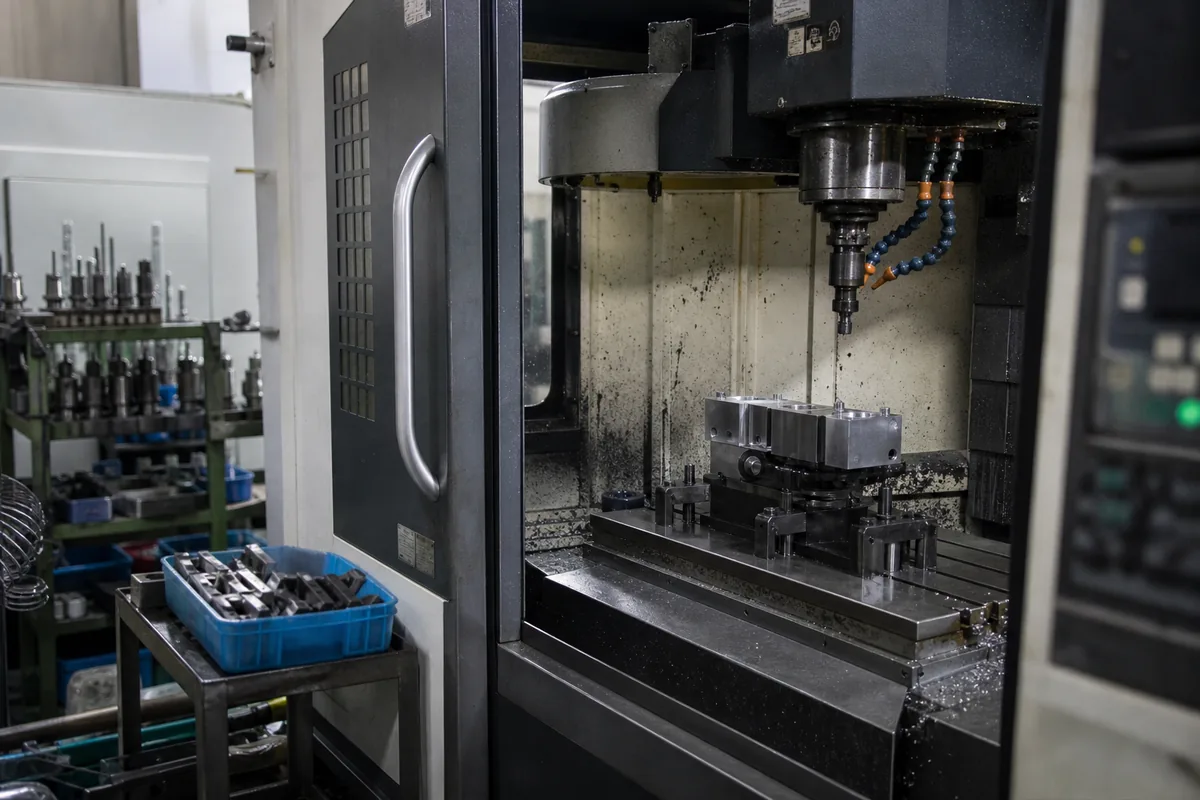
Rotating multi-flute cutters remove material as the Aluminum workpiece is driven through programmed tool paths on 3-, 4- or 5-axis machining centres. Climb milling, step-over and depth-of-cut are set so chip load stays in the ideal band for the alloy.
Programming is driven directly by your 3D model or print. Work-holding, tool selection and the cutting strategy are planned around the critical features and the material before the first chip is cut. First-off inspection confirms the process is centred before production continues.
Achievable Tolerances for CNC Precision Machining Aluminum
| Feature | Standard | Precision |
|---|---|---|
| Linear dimension (< 100 mm) | ±0.05 mm | ±0.010 mm |
| Linear dimension (100–300 mm) | ±0.10 mm | ±0.025 mm |
| Hole diameter (reamed) | H9 | H7 |
| True position of hole pattern | ±0.10 mm | ±0.025 mm |
| Flatness over 100 mm | 0.05 mm | 0.015 mm |
| Perpendicularity | 0.10 mm | 0.020 mm |
| Surface finish, as machined | Ra 1.6 µm | Ra 0.4 µm |
Standard is what a normal quotation assumes. Precision is available on nominated features and is priced separately, because it needs extra setups, in-process gauging and CMM verification. Call out only the features that need it — blanket-tightening a drawing is the single most common reason a quote comes back expensive.
Design Tips for CNC Precision Machining Aluminum
We are happy to suggest design tweaks that improve manufacturability. Generous internal radii, sensible pocket depth-to-width ratios and avoiding very thin unsupported walls all reduce cost and improve accuracy in Aluminum. If you send your model early, we will return practical DFM feedback before you commit to production.
Secondary Operations & Finishing
Finished Aluminum parts can move straight into secondary operations under one roof. Typical add-ons are deburring, passivation, anodising, plating, blasting, polishing and laser marking. We coordinate the whole chain so you receive complete, inspection-ready parts.
Working with Aluminum
As a material, Aluminum is lightweight, excellent machinability, good corrosion resistance. Our setup reflects the alloy's machinability so the finished part is accurate and free of avoidable defects.
We verify the exact grade and condition before machining, and traceable mill certs are available on request. We can work to your nominated material source or specification when required.
CNC Precision Machining Quality & Inspection
We control quality throughout the process, not just at the end. In-process checks plus final inspection — including CMM where specified — keep every Aluminum part to print. Inspection reports, material certificates and first-article documentation can be supplied on request.
CNC Precision Machining Tolerances & Surface Finish
For CNC Precision Machining, dimensional and positional tolerances around ±0.01 mm are routine, tightening toward ±0.005 mm on precision setups. Surface finish on machined faces typically falls in the Ra 0.4–1.6 µm range depending on tooling and pass strategy.
Exact achievable figures depend on the alloy, the feature size and the part geometry. Tell us which dimensions are critical and we will advise feasibility up front.
Applications of CNC Precision Machining Aluminum
Customers order CNC Precision Machining Aluminum components for everything from instrumentation to structural and functional assemblies. Whether you need a single prototype or recurring production volume, the same process discipline applies.
How to Order CNC Precision Machining Aluminum
Getting a quote is simple. Share your model, the material grade, your quantity and target tolerances. You receive a clear quotation with lead time and honest manufacturability feedback.
Parts We Have Run in Aluminum
Three representative CNC Precision Machining Aluminum jobs, with the callouts that actually drove the process plan. Yours will differ — these are here so you can judge whether your part is in our range before you spend time on an RFQ.
Heat sink base
- Material
- Aluminum
- Size
- 200 × 100 × 8 mm
- Key callouts
- Fin thickness 1.2 ±0.05 mm, base flatness 0.03 mm
- Batch
- 500 pcs
Fins cut with a slotting cutter in one pass to avoid the deflection a step-over leaves.
Manifold block
- Material
- Aluminum
- Size
- 120 × 60 × 45 mm
- Key callouts
- Cross-bore intersection ±0.05 mm, ports G1/8", leak-tested to 10 bar
- Batch
- 80 pcs
Deburred internally with a brush tool; a burr at a cross-bore is what fails the leak test.
Robot end-effector bracket
- Material
- Aluminum
- Size
- 180 × 90 × 30 mm
- Key callouts
- Bore pair concentric within 0.02 mm, weight reduction pockets
- Batch
- 120 pcs
Pockets ganged so wall thickness never drops below 2 mm at the load path.
Finishing Options for Aluminum
| Finish | Thickness / effect | Why it gets specified |
|---|---|---|
| Clear anodise (Type II) | 5–25 µm | Corrosion protection, keeps the natural colour |
| Colour anodise | 10–25 µm | Black, red, blue, gold; add 0.02 mm to close tolerances |
| Hard anodise (Type III) | 25–50 µm | 60–70 HRC surface, grows 50% into the part |
| Chromate / Alodine 1200 | < 1 µm | Conductive, meets MIL-DTL-5541 |
| Powder coat | 60–120 µm | RAL colours, needs 0.3 mm clearance on mating features |
| Deburr / edge break | 0.05–0.3 mm | All parts unless the drawing says otherwise |
| Bead blast | Ra 1.6–3.2 µm | Uniform matt finish, hides tool marks |
| Laser marking | — | Part number, lot code, data matrix |
No drawing yet? Build one in the browser.
Set the metal, dimensions and features, watch the 3D model update as you type, then switch to the 2D sheet to add dimensions and tolerances. Download it or send it straight to us with your RFQ.
What We Need to Quote CNC Precision Machining Aluminum
- GeometrySTEP or IGES for the 3D model, plus a PDF drawing if you have tolerance callouts. A dimensioned sketch is enough to start.
- MaterialThe exact Aluminum grade and condition — temper, heat-treat state or hardness. If you are not sure, tell us the function and we will suggest one.
- QuantityPrototype count and the expected annual volume. Both change how the part is made and therefore what it costs.
- TolerancesWhich features are critical. Everything else runs to our standard tolerance, which is what keeps the price sensible.
- FinishSurface treatment, cosmetic requirements, and any faces that must be masked.
- DocumentsWhether you need a material certificate, dimensional report, FAIR or PPAP with the shipment.
Missing something from the list is not a problem — send what you have. We will come back with the specific questions rather than a generic form.
Other Metals for CNC Precision Machining
Other Processes for Aluminum
Send the drawing, the Aluminum grade and the quantity. You get pricing, lead time and any DFM notes back — usually within one business day.
Request a QuoteFrequently Asked Questions
Why is Aluminum a good choice for CNC Precision Machining?
Aluminum is lightweight, excellent machinability, good corrosion resistance, which makes it well suited to CNC Precision Machining. We tune the process to the alloy so the finished Aluminum machining part meets your dimensional and functional requirements.
Which industries use CNC Precision Machining Aluminum parts?
CNC Precision Machining Aluminum parts are used across aerospace, medical, automotive, electronics, semiconductor and general industrial sectors — anywhere precise Aluminum components are required.
What is CNC Precision Machining Aluminum and how is it done?
CNC Precision Machining Aluminum refers to precision machining combines processes and inspection to hold the tightest dimensional and geometric tolerances. Applied to Aluminum — lightweight, excellent machinability, good corrosion resistance — VT machining produces each part to your CAD drawing, selecting parameters from your tolerance, finish and quantity requirements.
What is the typical lead time and minimum order for CNC Precision Machining Aluminum?
CNC Precision Machining prototypes for Aluminum can be produced quickly and scaled to series production. Send your drawing and quantity and we will advise lead time and any minimum order.
What tolerances can you hold for CNC Precision Machining Aluminum?
Achievable tolerances for Aluminum machining depend on the alloy, geometry and feature size. Milling holds positional and dimensional tolerances to around ±0.01 mm, tighter with precision setups. Exact figures are confirmed against your drawing callouts.