CNC Honing Aluminum from VT machining delivers precision Aluminum parts produced to your exact drawing. Honing finishes bores with abrasive stones to precise size, roundness and a cross-hatch surface, and we tune every parameter to the behaviour of Aluminum, which is lightweight, excellent machinability, good corrosion resistance.
Process Data for CNC Honing Aluminum
| Stone | Silicon carbide |
|---|---|
| Size tolerance | Ø ±0.002-0.005 mm, roundness ≤0.002 mm |
| Surface finish | Ra 0.2-0.4 µm |
Shown for 6061 Aluminum, the most common Aluminum grade we see for CNC Honing. Typical values for 6061 Aluminum, T6 / T651; confirmed on the first part.
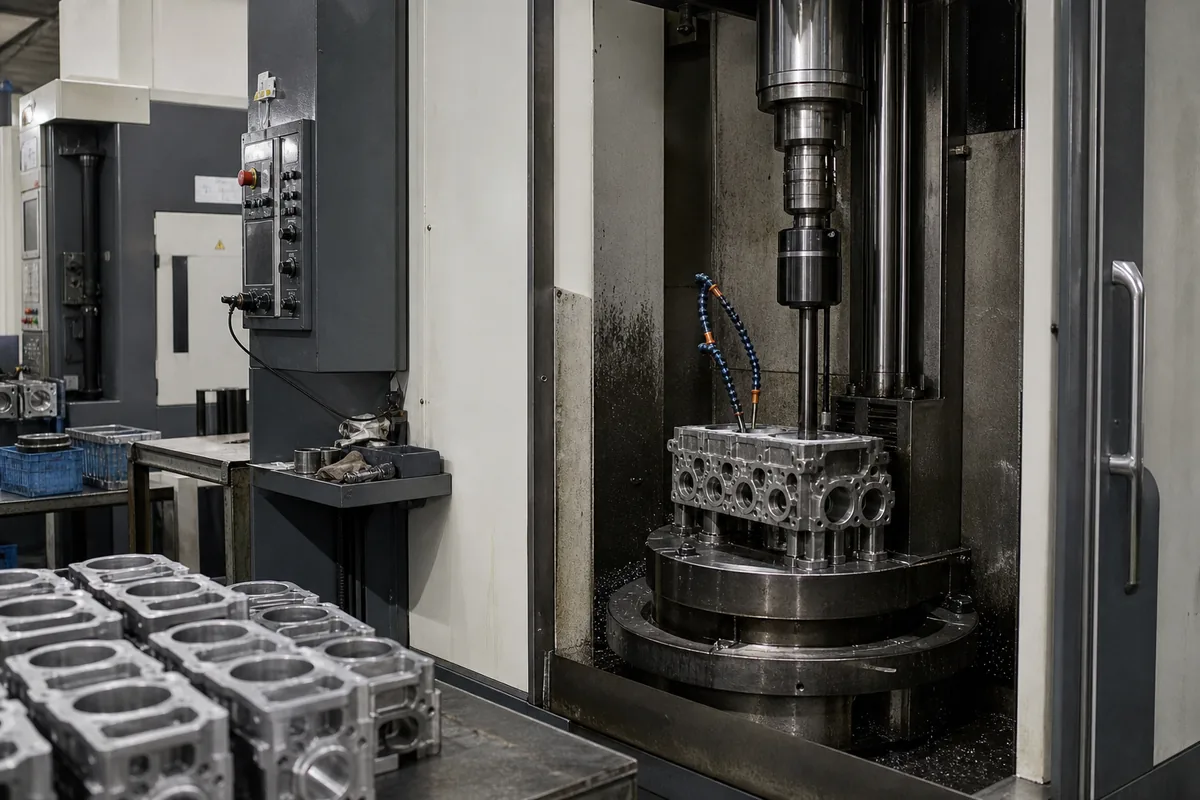
CNC Honing Capability for Aluminum
- Bore Ra to 0.1 µm
- Cross-hatch pattern
- Roundness within 0.002 mm
- Hydraulic-bore finishing
Aluminum material properties, finishing options and grade notes are on our CNC Polishing Aluminum page.
How CNC Honing Aluminum Works
Abrasive media or tooling refine the Aluminum surface in controlled stages, removing the previous step's marks until the target roughness and edge condition are reached.
Programming is driven directly by your 3D model or print. Work-holding, tool selection and the cutting strategy are planned around the critical features and the material before the first chip is cut. First-off inspection confirms the process is centred before production continues.
Achievable Tolerances for CNC Honing Aluminum
| Feature | Standard | Precision |
|---|---|---|
| Surface roughness | Ra 0.8 µm | Ra 0.05 µm |
| Edge break | 0.1–0.3 mm | 0.05 ±0.02 mm |
| Material removed | 0.02 mm | 0.005 mm |
| Bore roundness after honing | 0.005 mm | 0.002 mm |
| Cross-hatch angle | 45° ±10° | 45° ±5° |
| Cosmetic grade | uniform satin | mirror, no visible lines |
| Masking of datum faces | on request | standard |
Standard is what a normal quotation assumes. Precision is available on nominated features and is priced separately, because it needs extra setups, in-process gauging and CMM verification. Call out only the features that need it — blanket-tightening a drawing is the single most common reason a quote comes back expensive.
Design Tips for CNC Honing Aluminum
We are happy to suggest design tweaks that improve manufacturability. Telling us the target Ra, the cosmetic faces and any masking needs lets us finish Aluminum efficiently without over-processing. If you send your model early, we will return practical DFM feedback before you commit to production.
CNC Honing Tolerances & Surface Finish
Finishing brings Aluminum to a defined roughness target — from a uniform satin to Ra values as low as 0.05 µm — with controlled, repeatable edge breaks.
Exact achievable figures depend on the alloy, the feature size and the part geometry. Tell us which dimensions are critical and we will advise feasibility up front.
Applications of CNC Honing Aluminum
Customers order CNC Honing Aluminum components for everything from instrumentation to structural and functional assemblies. Whether you need a single prototype or recurring production volume, the same process discipline applies.
Typical Aluminum Parts for CNC Honing
Illustrative examples of CNC Honing Aluminum parts and the callouts that usually drive the process plan. They show the kind of work that fits this process; they are not specific customer orders.
Deburred stamping
- Material
- Aluminum
- Size
- 40 × 25 × 1 mm
- Key callouts
- Edge break 0.05–0.15 mm, no sharp edges
- Batch
- 30,000 pcs
Vibratory finished in media sized to reach every internal cutout.
Cosmetic housing
- Material
- Aluminum
- Size
- 150 × 90 mm visible face
- Key callouts
- Uniform satin, no directional lines
- Batch
- 2,500 pcs
Grained in one direction with datum faces masked so they keep their tolerance.
Mirror-polished insert
- Material
- Aluminum
- Size
- 80 × 50 mm cavity
- Key callouts
- Ra 0.05 µm, SPI A2
- Batch
- 60 pcs
Polished in five abrasive stages; skipping one leaves scratches the next cannot remove.
No drawing yet? Build one in the browser.
Set the metal, dimensions and features, watch the 3D model update as you type, then switch to the 2D sheet to add dimensions and tolerances. Download it or send it straight to us with your RFQ.
What We Need to Quote CNC Honing Aluminum
- GeometrySTEP or IGES for the 3D model, plus a PDF drawing if you have tolerance callouts. A dimensioned sketch is enough to start.
- MaterialThe exact Aluminum grade and condition — temper, heat-treat state or hardness. If you are not sure, tell us the function and we will suggest one.
- QuantityPrototype count and the expected annual volume. Both change how the part is made and therefore what it costs.
- TolerancesWhich features are critical. Everything else runs to our standard tolerance, which is what keeps the price sensible.
- FinishSurface treatment, cosmetic requirements, and any faces that must be masked.
- DocumentsWhether you need a material certificate, dimensional report, FAIR or PPAP with the shipment.
Missing something from the list is not a problem — send what you have. We will come back with the specific questions rather than a generic form.
Other Metals for CNC Honing
Other Processes for Aluminum
Send the drawing, the Aluminum grade and the quantity. You get pricing, lead time and any DFM notes back — usually within one business day.
Request a QuoteFrequently Asked Questions
What surface finish is achievable on Aluminum with CNC Honing?
Our finishing processes refine Aluminum surfaces to Ra values as low as 0.05 µm for cosmetic or sealing faces.
Which industries use CNC Honing Aluminum parts?
CNC Honing Aluminum parts are used across aerospace, medical, automotive, electronics, semiconductor and general industrial sectors — anywhere precise Aluminum components are required.
What tolerances can you hold for CNC Honing Aluminum?
Achievable tolerances for Aluminum finishing depend on the alloy, geometry and feature size. We hold tight, repeatable tolerances appropriate to the feature and material. Exact figures are confirmed against your drawing callouts.
Can VT machining make custom Aluminum parts to my drawing?
Yes. Aluminum finishing is made to order from your CAD/2D drawing. Share your geometry, material grade, tolerance and quantity and we will confirm feasibility, lead time and pricing.
Why is Aluminum a good choice for CNC Honing?
Aluminum is lightweight, excellent machinability, good corrosion resistance, which makes it well suited to CNC Honing. We tune the process to the alloy so the finished Aluminum finishing part meets your dimensional and functional requirements.