
Looking for reliable CNC Milling Alloy Steel? VT machining manufactures Alloy Steel parts to tight tolerances and consistent quality. Alloy Steel is high strength and hardenability for demanding parts, so the process is set up specifically for the material.
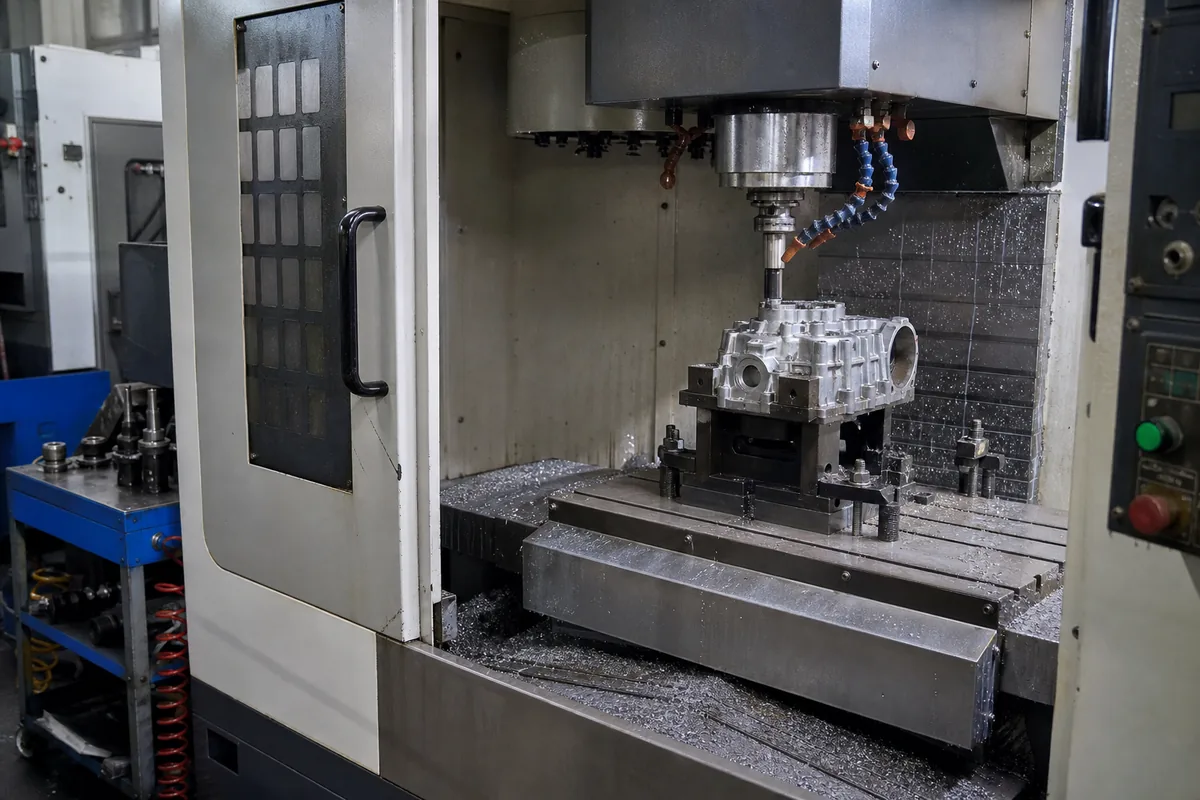
CNC Milling Capability for Alloy Steel
- 3-, 4- and 5-axis capability
- Tolerance to ±0.01 mm
- Pocket/slot/contour features
- Spindle speeds to 12,000+ rpm
Alloy Steel Material Data
| Density | 7.85 g/cm³ |
|---|---|
| Tensile strength | 655–1020 MPa |
| Yield strength (0.2%) | 415–900 MPa |
| Hardness | 197–302 HB |
| Melting point | 1416 °C |
| Thermal conductivity | 42.6 W/m·K |
| Thermal expansion | 12.3 ×10⁻⁶/K |
| Electrical conductivity | 8% |
| Machinability (C36000 = 100%) | 65% (annealed) |
| Grades we run | 4140, 4340, 8620, 20CrMnTi, 42CrMo4, 20MnCr5 |
Published typical values for 4140 (Q&T). Other grades in the family differ — the certificate supplied with your order carries the actual heat-lot figures.
Heat treatment moves the part. Anything held tighter than ±0.02 mm is machined soft, hardened, then ground or hard-turned to final size.
How CNC Milling Alloy Steel Works
Rotating multi-flute cutters remove material as the Alloy Steel workpiece is driven through programmed tool paths on 3-, 4- or 5-axis machining centres. Climb milling, step-over and depth-of-cut are set so chip load stays in the ideal band for the alloy.
Every job begins from your CAD model or 2D drawing. Fixturing and tool paths are planned so the most critical dimensions are produced in the most rigid, repeatable setup. Critical dimensions are checked on the first part and monitored through the run.
Achievable Tolerances for CNC Milling Alloy Steel
| Feature | Standard | Precision |
|---|---|---|
| Linear dimension (< 100 mm) | ±0.05 mm | ±0.010 mm |
| Linear dimension (100–300 mm) | ±0.10 mm | ±0.025 mm |
| Hole diameter (reamed) | H9 | H7 |
| True position of hole pattern | ±0.10 mm | ±0.025 mm |
| Flatness over 100 mm | 0.05 mm | 0.015 mm |
| Perpendicularity | 0.10 mm | 0.020 mm |
| Surface finish, as machined | Ra 1.6 µm | Ra 0.4 µm |
Standard is what a normal quotation assumes. Precision is available on nominated features and is priced separately, because it needs extra setups, in-process gauging and CMM verification. Call out only the features that need it — blanket-tightening a drawing is the single most common reason a quote comes back expensive.
Secondary Operations & Finishing
We complete Alloy Steel components with the secondary steps your drawing calls for. We arrange heat treatment, surface treatment, marking and assembly as needed. Tell us the final spec and we will plan the full route so parts arrive ready to use.
Design Tips for CNC Milling Alloy Steel
A few design choices make a real difference to cost and quality. Generous internal radii, sensible pocket depth-to-width ratios and avoiding very thin unsupported walls all reduce cost and improve accuracy in Alloy Steel. If you send your model early, we will return practical DFM feedback before you commit to production.
CNC Milling Quality & Inspection
Consistent quality comes from disciplined process control. Critical dimensions on Alloy Steel parts are checked in-process and verified at final inspection using calibrated instruments and, where required, CMM measurement. Full documentation — dimensional reports, mill certs, FAIR — is available when your programme needs it.
CNC Milling Tolerances & Surface Finish
For CNC Milling, dimensional and positional tolerances around ±0.01 mm are routine, tightening toward ±0.005 mm on precision setups. Surface finish on machined faces typically falls in the Ra 0.4–1.6 µm range depending on tooling and pass strategy.
Final tolerances are governed by the material's behaviour, wall thickness and overall stiffness. We give honest DFM feedback if a callout would be costly or better achieved another way.
Working with Alloy Steel
Alloy Steel offers a useful combination of properties: it is high strength and hardenability for demanding parts. Those characteristics shape how we approach milling — from tool and parameter selection to work-holding and coolant.
If your application is sensitive to alloy condition, we agree the specification in writing and document it. Stock is sourced from reputable suppliers so what you order is what you receive.
Applications of CNC Milling Alloy Steel
CNC Milling of Alloy Steel supports parts across aerospace, medical, automotive, electronics, semiconductor, energy and general industrial sectors. We scale from one-off prototypes to ongoing production while holding the same quality.
How to Order CNC Milling Alloy Steel
Ordering Alloy Steel parts is straightforward. Provide the drawing, material, quantity and any certification needs. Our engineers reply — in English — with feasibility, pricing and a realistic lead time, usually within one business day.
Parts We Have Run in Alloy Steel
Three representative CNC Milling Alloy Steel jobs, with the callouts that actually drove the process plan. Yours will differ — these are here so you can judge whether your part is in our range before you spend time on an RFQ.
Manifold block
- Material
- Alloy Steel
- Size
- 120 × 60 × 45 mm
- Key callouts
- Cross-bore intersection ±0.05 mm, ports G1/8", leak-tested to 10 bar
- Batch
- 80 pcs
Deburred internally with a brush tool; a burr at a cross-bore is what fails the leak test.
Heat sink base
- Material
- Alloy Steel
- Size
- 200 × 100 × 8 mm
- Key callouts
- Fin thickness 1.2 ±0.05 mm, base flatness 0.03 mm
- Batch
- 500 pcs
Fins cut with a slotting cutter in one pass to avoid the deflection a step-over leaves.
Optical mount plate
- Material
- Alloy Steel
- Size
- 160 × 160 × 12 mm
- Key callouts
- Hole pattern true position ±0.02 mm, flatness 0.01 mm
- Batch
- 40 pcs
Roughed, stress-relieved overnight, then finished — the plate is too thin to hold flatness in one hit.
Finishing Options for Alloy Steel
| Finish | Thickness / effect | Why it gets specified |
|---|---|---|
| Through hardening | — | 30–55 HRC, ground afterwards for tight sizes |
| Case hardening (carburise) | 0.3–1.2 mm case | 58–62 HRC surface, tough core |
| Nitride | 0.1–0.5 mm | 900–1100 HV, minimal distortion |
| Black oxide | 1–2 µm | Cosmetic + light corrosion protection |
| Zinc / nickel plate | 5–25 µm | Corrosion protection |
| Deburr / edge break | 0.05–0.3 mm | All parts unless the drawing says otherwise |
| Bead blast | Ra 1.6–3.2 µm | Uniform matt finish, hides tool marks |
| Laser marking | — | Part number, lot code, data matrix |
No drawing yet? Build one in the browser.
Set the metal, dimensions and features, watch the 3D model update as you type, then switch to the 2D sheet to add dimensions and tolerances. Download it or send it straight to us with your RFQ.
What We Need to Quote CNC Milling Alloy Steel
- GeometrySTEP or IGES for the 3D model, plus a PDF drawing if you have tolerance callouts. A dimensioned sketch is enough to start.
- MaterialThe exact Alloy Steel grade and condition — temper, heat-treat state or hardness. If you are not sure, tell us the function and we will suggest one.
- QuantityPrototype count and the expected annual volume. Both change how the part is made and therefore what it costs.
- TolerancesWhich features are critical. Everything else runs to our standard tolerance, which is what keeps the price sensible.
- FinishSurface treatment, cosmetic requirements, and any faces that must be masked.
- DocumentsWhether you need a material certificate, dimensional report, FAIR or PPAP with the shipment.
Missing something from the list is not a problem — send what you have. We will come back with the specific questions rather than a generic form.
Other Metals for CNC Milling
Other Processes for Alloy Steel
Send the drawing, the Alloy Steel grade and the quantity. You get pricing, lead time and any DFM notes back — usually within one business day.
Request a QuoteFrequently Asked Questions
Which industries use CNC Milling Alloy Steel parts?
CNC Milling Alloy Steel parts are used across aerospace, medical, automotive, electronics, semiconductor and general industrial sectors — anywhere precise Alloy Steel components are required.
What is the typical lead time and minimum order for CNC Milling Alloy Steel?
CNC Milling prototypes for Alloy Steel can be produced quickly and scaled to series production. Send your drawing and quantity and we will advise lead time and any minimum order.
What is CNC Milling Alloy Steel and how is it done?
CNC Milling Alloy Steel refers to multi-axis milling cutters remove material to produce prismatic features, pockets, slots and contoured 3D surfaces. Applied to Alloy Steel — high strength and hardenability for demanding parts — VT machining produces each part to your CAD drawing, selecting parameters from your tolerance, finish and quantity requirements.
What tolerances can you hold for CNC Milling Alloy Steel?
Achievable tolerances for Alloy Steel machining depend on the alloy, geometry and feature size. Milling holds positional and dimensional tolerances to around ±0.01 mm, tighter with precision setups. Exact figures are confirmed against your drawing callouts.
Why is Alloy Steel a good choice for CNC Milling?
Alloy Steel is high strength and hardenability for demanding parts, which makes it well suited to CNC Milling. We tune the process to the alloy so the finished Alloy Steel machining part meets your dimensional and functional requirements.
Does CNC Milling Alloy Steel require dedicated tooling?
Most Alloy Steel machining work uses standard cutting tools and CNC programs; dedicated fixtures are made only when geometry or volume requires them.