
VT machining provides CNC Gear Hobbing Copper for customers who need accurate, repeatable Copper components. Because Copper is excellent electrical and thermal conductivity, we adapt the process to suit — controlling the variables that matter for this alloy.
Process Data for CNC Gear Hobbing Copper
| Heat-treat route | As specified on drawing |
|---|---|
| Accuracy as cut | ISO 1328 class 8-9 (AGMA 9-10) |
| Module range | 0.3-6 |
| Hobbing speed (HSS-E / carbide) | 40 / 120 m/min |
| Hob | HSS-E (PM) coated hob; carbide for dry hobbing |
| Gear types | External spur and helical, splines, worm wheels |
Shown for C110 Copper, the most common Copper grade we see for CNC Gear Hobbing. Typical values for C110 Copper, Annealed or H02; confirmed on the first part.
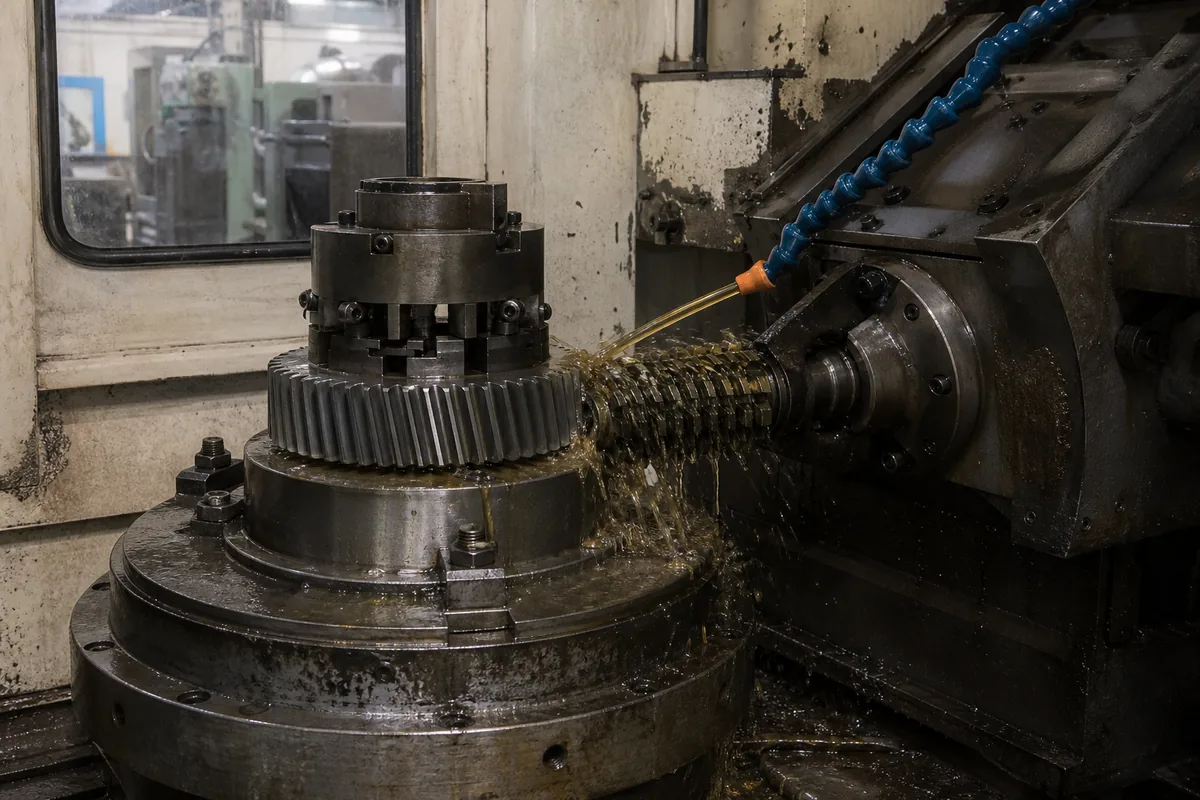
CNC Gear Hobbing Capability for Copper
- Spur & helical gears
- Module range support
- Pre-grind accuracy
- High productivity
Copper Material Data
| Density | 8.94 g/cm³ |
|---|---|
| Tensile strength | 220–350 MPa |
| Yield strength (0.2%) | 70–330 MPa |
| Hardness | 40–100 HV |
| Melting point | 1083 °C |
| Thermal conductivity | 391 W/m·K |
| Thermal expansion | 17.0 ×10⁻⁶/K |
| Electrical conductivity | 101% |
| Machinability (C36000 = 100%) | 20% |
| Grades we run | C10100 OFE, C10200 OF, C11000 ETP, C14500 tellurium copper |
Published typical values for C11000 ETP. Other grades in the family differ — the certificate supplied with your order carries the actual heat-lot figures.
It smears rather than cuts. Razor-sharp uncoated tooling and high rake; if the print allows it, C14500 tellurium copper machines four times better at ~90% IACS.
How CNC Gear Hobbing Copper Works
Tooth profiles are generated in the Copper blank by a synchronised cutter, then refined to the required accuracy class. Module, pressure angle and helix are programmed from your gear data.
Programming is driven directly by your 3D model or print. Work-holding, tool selection and the cutting strategy are planned around the critical features and the material before the first chip is cut. First-off inspection confirms the process is centred before production continues.
Achievable Tolerances for CNC Gear Hobbing Copper
| Feature | Standard | Precision |
|---|---|---|
| Accuracy class | DIN 8 / AGMA 10 | DIN 6 / AGMA 12 |
| Profile deviation | 0.020 mm | 0.008 mm |
| Lead deviation | 0.020 mm | 0.008 mm |
| Pitch deviation (cumulative) | 0.040 mm | 0.015 mm |
| Runout | 0.030 mm | 0.010 mm |
| Tooth surface finish | Ra 1.6 µm | Ra 0.4 µm (ground) |
| Module range | m0.5–m8 | m1–m6 |
Standard is what a normal quotation assumes. Precision is available on nominated features and is priced separately, because it needs extra setups, in-process gauging and CMM verification. Call out only the features that need it — blanket-tightening a drawing is the single most common reason a quote comes back expensive.
CNC Gear Hobbing Tolerances & Surface Finish
Gear features are produced to a specified DIN/AGMA accuracy class, with profile and lead controlled for quiet, durable running under load.
Exact achievable figures depend on the alloy, the feature size and the part geometry. Tell us which dimensions are critical and we will advise feasibility up front.
Design Tips for CNC Gear Hobbing Copper
We are happy to suggest design tweaks that improve manufacturability. Providing complete gear data (module, pressure angle, profile shift, quality class) lets us produce Copper gears right the first time. If you send your model early, we will return practical DFM feedback before you commit to production.
Working with Copper
As a material, Copper is excellent electrical and thermal conductivity. Our setup reflects the alloy's machinability so the finished part is accurate and free of avoidable defects.
We verify the exact grade and condition before machining, and traceable mill certs are available on request. We can work to your nominated material source or specification when required.
Applications of CNC Gear Hobbing Copper
Customers order CNC Gear Hobbing Copper components for everything from instrumentation to structural and functional assemblies. Whether you need a single prototype or recurring production volume, the same process discipline applies.
Typical Copper Parts for CNC Gear Hobbing
Illustrative examples of CNC Gear Hobbing Copper parts and the callouts that usually drive the process plan. They show the kind of work that fits this process; they are not specific customer orders.
Internal ring gear
- Material
- Copper
- Size
- m2.5, z72, ID 190 mm
- Key callouts
- DIN 8, pitch deviation 0.03 mm
- Batch
- 150 pcs
Shaped rather than hobbed — an internal gear leaves no room for a hob to run out.
Worm and wheel set
- Material
- Copper
- Size
- m3, single start
- Key callouts
- Backlash 0.05–0.10 mm as a matched pair
- Batch
- 120 sets
Supplied as matched sets and marked, because mixing pairs loses the backlash spec.
Splined shaft
- Material
- Copper
- Size
- DIN 5480, 26 × 1.5
- Key callouts
- Fit class H7/g6, runout 0.02 mm
- Batch
- 800 pcs
Spline hobbed with the journals ground afterwards on the same centres.
Finishing Options for Copper
| Finish | Thickness / effect | Why it gets specified |
|---|---|---|
| Tin plate | 3–15 µm | Solderable, prevents oxidation |
| Silver plate | 2–10 µm | Lowest contact resistance for RF and power |
| Nickel underplate | 2–5 µm | Diffusion barrier under tin or gold |
| Gold flash | 0.05–1 µm | Contact surfaces, over nickel |
| Deburr / edge break | 0.05–0.3 mm | All parts unless the drawing says otherwise |
| Bead blast | Ra 1.6–3.2 µm | Uniform matt finish, hides tool marks |
| Laser marking | — | Part number, lot code, data matrix |
No drawing yet? Build one in the browser.
Set the metal, dimensions and features, watch the 3D model update as you type, then switch to the 2D sheet to add dimensions and tolerances. Download it or send it straight to us with your RFQ.
What We Need to Quote CNC Gear Hobbing Copper
- GeometrySTEP or IGES for the 3D model, plus a PDF drawing if you have tolerance callouts. A dimensioned sketch is enough to start.
- MaterialThe exact Copper grade and condition — temper, heat-treat state or hardness. If you are not sure, tell us the function and we will suggest one.
- QuantityPrototype count and the expected annual volume. Both change how the part is made and therefore what it costs.
- TolerancesWhich features are critical. Everything else runs to our standard tolerance, which is what keeps the price sensible.
- FinishSurface treatment, cosmetic requirements, and any faces that must be masked.
- DocumentsWhether you need a material certificate, dimensional report, FAIR or PPAP with the shipment.
Missing something from the list is not a problem — send what you have. We will come back with the specific questions rather than a generic form.
Other Metals for CNC Gear Hobbing
Other Processes for Copper
Send the drawing, the Copper grade and the quantity. You get pricing, lead time and any DFM notes back — usually within one business day.
Request a QuoteFrequently Asked Questions
What surface finish is achievable on Copper with CNC Gear Hobbing?
Surface finish on Copper is controlled to your specification; we confirm the achievable Ra against your callout.
What material thickness or size range suits CNC Gear Hobbing Copper?
We machine Copper across a broad size range; share your part envelope for confirmation.
Why is Copper a good choice for CNC Gear Hobbing?
Copper is excellent electrical and thermal conductivity, which makes it well suited to CNC Gear Hobbing. We tune the process to the alloy so the finished Copper gear cutting part meets your dimensional and functional requirements.
What is CNC Gear Hobbing Copper and how is it done?
CNC Gear Hobbing Copper refers to gear hobbing generates gear teeth with a rotating hob synchronized to the workpiece. Applied to Copper — excellent electrical and thermal conductivity — VT machining produces each part to your CAD drawing, selecting parameters from your tolerance, finish and quantity requirements.
Does CNC Gear Hobbing Copper require dedicated tooling?
Most Copper gear cutting work uses standard cutting tools and CNC programs; dedicated fixtures are made only when geometry or volume requires them.