
VT machining provides CNC 4-Axis Machining Nickel for customers who need accurate, repeatable Nickel components. Because Nickel is corrosion and heat resistant, we adapt the process to suit — controlling the variables that matter for this alloy.
Starting Parameters for CNC 4-Axis Machining Nickel
| Cutting speed (carbide) | 40-95 m/min |
|---|---|
| Feed per tooth | 0.028-0.07 mm |
| Spindle speed, Ø10 mm end mill | 1270-3020 rpm |
| Insert / tool class | ISO S — sharp PVD-coated carbide |
| Coolant | Flood emulsion |
| Rotary positioning accuracy | ±10 arc-sec (≈ ±0.005 mm at Ø100 mm) |
Shown for Nickel 200, the most common Nickel grade we see for CNC 4-Axis Machining. Starting values for Nickel 200, Annealed; optimised on the first article.
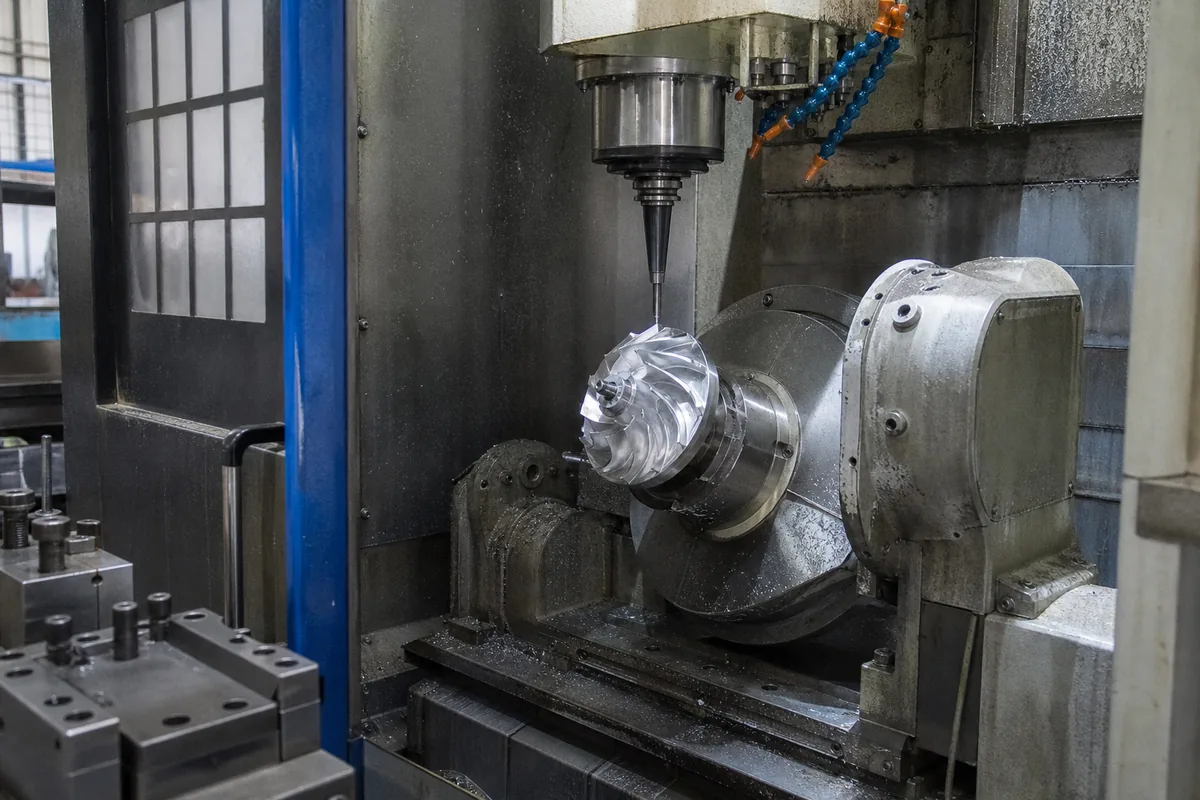
CNC 4-Axis Machining Capability for Nickel
- Indexed & continuous 4th axis
- Multi-face in one setup
- Tolerance to ±0.01 mm
- Rotary fixturing
Nickel material properties, finishing options and grade notes are on our CNC Milling Nickel page.
How CNC 4-Axis Machining Nickel Works
Rotating multi-flute cutters remove material as the Nickel workpiece is driven through programmed tool paths on 3-, 4- or 5-axis machining centres. Climb milling, step-over and depth-of-cut are set so chip load stays in the ideal band for the alloy.
Programming is driven directly by your 3D model or print. Work-holding, tool selection and the cutting strategy are planned around the critical features and the material before the first chip is cut. First-off inspection confirms the process is centred before production continues.
Achievable Tolerances for CNC 4-Axis Machining Nickel
| Feature | Standard | Precision |
|---|---|---|
| Linear dimension (< 100 mm) | ±0.05 mm | ±0.010 mm |
| Linear dimension (100–300 mm) | ±0.10 mm | ±0.025 mm |
| Hole diameter (reamed) | H9 | H7 |
| True position of hole pattern | ±0.10 mm | ±0.025 mm |
| Flatness over 100 mm | 0.05 mm | 0.015 mm |
| Perpendicularity | 0.10 mm | 0.020 mm |
| Surface finish, as machined | Ra 1.6 µm | Ra 0.4 µm |
Standard is what a normal quotation assumes. Precision is available on nominated features and is priced separately, because it needs extra setups, in-process gauging and CMM verification. Call out only the features that need it — blanket-tightening a drawing is the single most common reason a quote comes back expensive.
CNC 4-Axis Machining Tolerances & Surface Finish
For CNC 4-Axis Machining, dimensional and positional tolerances around ±0.01 mm are routine, tightening toward ±0.005 mm on precision setups. Surface finish on machined faces typically falls in the Ra 0.4–1.6 µm range depending on tooling and pass strategy.
Exact achievable figures depend on the alloy, the feature size and the part geometry. Tell us which dimensions are critical and we will advise feasibility up front.
Design Tips for CNC 4-Axis Machining Nickel
We are happy to suggest design tweaks that improve manufacturability. Generous internal radii, sensible pocket depth-to-width ratios and avoiding very thin unsupported walls all reduce cost and improve accuracy in Nickel. If you send your model early, we will return practical DFM feedback before you commit to production.
Applications of CNC 4-Axis Machining Nickel
Customers order CNC 4-Axis Machining Nickel components for everything from instrumentation to structural and functional assemblies. Whether you need a single prototype or recurring production volume, the same process discipline applies.
Typical Nickel Parts for CNC 4-Axis Machining
Illustrative examples of CNC 4-Axis Machining Nickel parts and the callouts that usually drive the process plan. They show the kind of work that fits this process; they are not specific customer orders.
Heat sink base
- Material
- Nickel
- Size
- 200 × 100 × 8 mm
- Key callouts
- Fin thickness 1.2 ±0.05 mm, base flatness 0.03 mm
- Batch
- 500 pcs
Fins cut with a slotting cutter in one pass to avoid the deflection a step-over leaves.
Manifold block
- Material
- Nickel
- Size
- 120 × 60 × 45 mm
- Key callouts
- Cross-bore intersection ±0.05 mm, ports G1/8", leak-tested to 10 bar
- Batch
- 80 pcs
Deburred internally with a brush tool; a burr at a cross-bore is what fails the leak test.
Robot end-effector bracket
- Material
- Nickel
- Size
- 180 × 90 × 30 mm
- Key callouts
- Bore pair concentric within 0.02 mm, weight reduction pockets
- Batch
- 120 pcs
Pockets ganged so wall thickness never drops below 2 mm at the load path.
No drawing yet? Build one in the browser.
Set the metal, dimensions and features, watch the 3D model update as you type, then switch to the 2D sheet to add dimensions and tolerances. Download it or send it straight to us with your RFQ.
What We Need to Quote CNC 4-Axis Machining Nickel
- GeometrySTEP or IGES for the 3D model, plus a PDF drawing if you have tolerance callouts. A dimensioned sketch is enough to start.
- MaterialThe exact Nickel grade and condition — temper, heat-treat state or hardness. If you are not sure, tell us the function and we will suggest one.
- QuantityPrototype count and the expected annual volume. Both change how the part is made and therefore what it costs.
- TolerancesWhich features are critical. Everything else runs to our standard tolerance, which is what keeps the price sensible.
- FinishSurface treatment, cosmetic requirements, and any faces that must be masked.
- DocumentsWhether you need a material certificate, dimensional report, FAIR or PPAP with the shipment.
Missing something from the list is not a problem — send what you have. We will come back with the specific questions rather than a generic form.
Other Metals for CNC 4-Axis Machining
Other Processes for Nickel
Send the drawing, the Nickel grade and the quantity. You get pricing, lead time and any DFM notes back — usually within one business day.
Request a QuoteFrequently Asked Questions
Which industries use CNC 4-Axis Machining Nickel parts?
CNC 4-Axis Machining Nickel parts are used across aerospace, medical, automotive, electronics, semiconductor and general industrial sectors — anywhere precise Nickel components are required.
Does CNC 4-Axis Machining Nickel require dedicated tooling?
Most Nickel machining work uses standard cutting tools and CNC programs; dedicated fixtures are made only when geometry or volume requires them.
How clean are the edges produced by CNC 4-Axis Machining on Nickel?
Machined Nickel edges are clean and to specification; edge-break or deburring is added when your drawing calls for it.
What is the typical lead time and minimum order for CNC 4-Axis Machining Nickel?
CNC 4-Axis Machining prototypes for Nickel can be produced quickly and scaled to series production. Send your drawing and quantity and we will advise lead time and any minimum order.
What surface finish is achievable on Nickel with CNC 4-Axis Machining?
Surface finish on Nickel is controlled to your specification; we confirm the achievable Ra against your callout.