Chemical Etching Titanium from VT machining delivers precision Titanium parts produced to your exact drawing. Photochemical etching uses a patterned resist and etchant to dissolve metal precisely, with no mechanical force, burrs or induced stress, and we tune every parameter to the behaviour of Titanium, which is biocompatible and corrosion resistant; etched for medical parts.
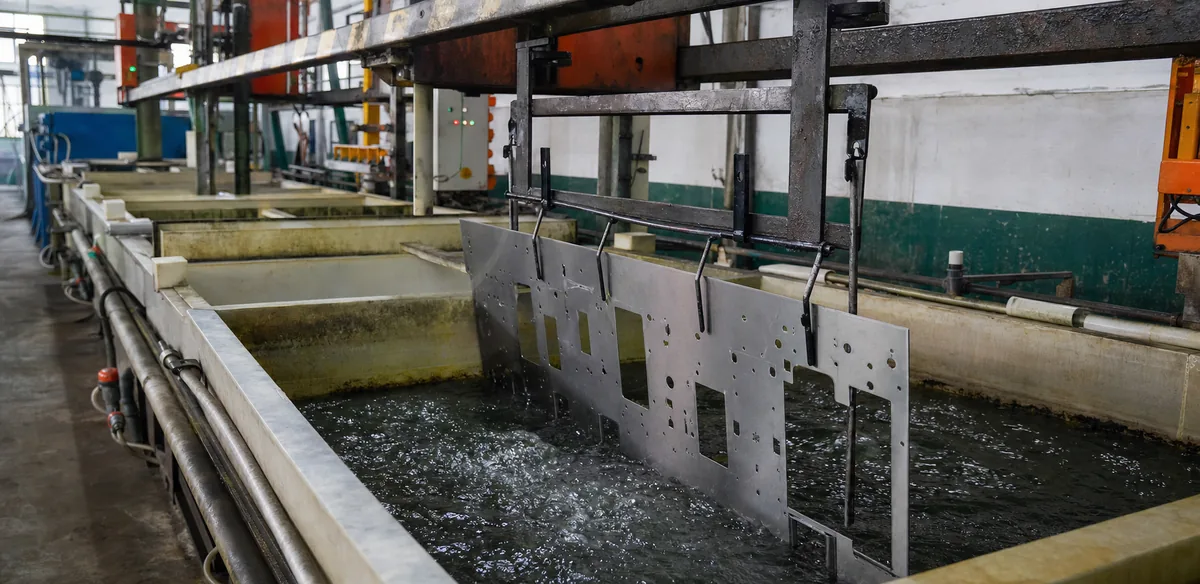
Chemical Etching Capability for Titanium
- Foil thickness 0.02–1.0 mm
- Minimum feature ≈ 0.8 × metal thickness
- Burr-free, stress-free edges
- Tooling-free: revise artwork digitally
Titanium Material Data
| Density | 4.43 g/cm³ |
|---|---|
| Tensile strength | 950 MPa |
| Yield strength (0.2%) | 880 MPa |
| Hardness | 334 HB / 36 HRC |
| Melting point | 1604–1660 °C |
| Thermal conductivity | 6.7 W/m·K |
| Thermal expansion | 8.6 ×10⁻⁶/K |
| Electrical conductivity | 3.1% |
| Machinability (C36000 = 100%) | 22% |
| Grades we run | Gr 1, Gr 2 (CP), Gr 5 Ti-6Al-4V, Gr 23 ELI, Gr 7, Gr 9 |
Published typical values for Ti-6Al-4V (Gr 5). Other grades in the family differ — the certificate supplied with your order carries the actual heat-lot figures.
Heat has nowhere to go — thermal conductivity is 1/25th of aluminium, so it all goes into the tool. Low surface speed, heavy feed, flood coolant, and the cutter never stops moving.
How Chemical Etching Titanium Works
A photo-resist patterned from your artwork masks the Titanium, and an etchant dissolves the exposed metal evenly from both sides. Because there is no mechanical force, the part stays flat and stress-free.
Every job begins from your CAD model or 2D drawing. Fixturing and tool paths are planned so the most critical dimensions are produced in the most rigid, repeatable setup. Critical dimensions are checked on the first part and monitored through the run.
Achievable Tolerances for Chemical Etching Titanium
| Feature | Standard | Precision |
|---|---|---|
| Feature dimension | ±0.05 mm | ±0.02 mm |
| Minimum feature width | 1.0 × thickness | 0.8 × thickness |
| Foil thickness range | 0.02–1.0 mm | 0.05–0.5 mm |
| Edge condition | burr-free | burr-free, no HAZ |
| Flatness of etched part | 0.1 mm over 100 mm | 0.05 mm over 100 mm |
| Half-etch depth control | ±20% of depth | ±10% of depth |
| Tab / breakout size | 0.5 mm | 0.3 mm |
Standard is what a normal quotation assumes. Precision is available on nominated features and is priced separately, because it needs extra setups, in-process gauging and CMM verification. Call out only the features that need it — blanket-tightening a drawing is the single most common reason a quote comes back expensive.
Chemical Etching Tolerances & Surface Finish
Etched Titanium holds tight, repeatable feature tolerances on thin gauge, with a minimum feature size around 0.8× the metal thickness and completely burr-free edges.
Final tolerances are governed by the material's behaviour, wall thickness and overall stiffness. We give honest DFM feedback if a callout would be costly or better achieved another way.
Design Tips for Chemical Etching Titanium
A few design choices make a real difference to cost and quality. Designing features no finer than ~0.8× foil thickness and allowing tab placement gives the best yield on etched Titanium. If you send your model early, we will return practical DFM feedback before you commit to production.
Working with Titanium
Titanium offers a useful combination of properties: it is biocompatible and corrosion resistant; etched for medical parts. Those characteristics shape how we approach chemical etching — from tool and parameter selection to work-holding and coolant.
If your application is sensitive to alloy condition, we agree the specification in writing and document it. Stock is sourced from reputable suppliers so what you order is what you receive.
Secondary Operations & Finishing
We complete Titanium components with the secondary steps your drawing calls for. We arrange heat treatment, surface treatment, marking and assembly as needed. Tell us the final spec and we will plan the full route so parts arrive ready to use.
Chemical Etching Quality & Inspection
Consistent quality comes from disciplined process control. Critical dimensions on Titanium parts are checked in-process and verified at final inspection using calibrated instruments and, where required, CMM measurement. Full documentation — dimensional reports, mill certs, FAIR — is available when your programme needs it.
Applications of Chemical Etching Titanium
Chemical Etching of Titanium supports parts across aerospace, medical, automotive, electronics, semiconductor, energy and general industrial sectors. We scale from one-off prototypes to ongoing production while holding the same quality.
How to Order Chemical Etching Titanium
Ordering Titanium parts is straightforward. Provide the drawing, material, quantity and any certification needs. Our engineers reply — in English — with feasibility, pricing and a realistic lead time, usually within one business day.
Parts We Have Run in Titanium
Three representative Chemical Etching Titanium jobs, with the callouts that actually drove the process plan. Yours will differ — these are here so you can judge whether your part is in our range before you spend time on an RFQ.
Lead frame
- Material
- Titanium
- Size
- 60 × 30 × 0.15 mm
- Key callouts
- Track width 0.15 ±0.02 mm, burr-free
- Batch
- 40,000 pcs
No mechanical force means no distortion — the frame is flat straight out of the etch line.
Filter screen
- Material
- Titanium
- Size
- Ø25 × 0.08 mm
- Key callouts
- 0.06 mm holes, 40% open area
- Batch
- 15,000 pcs
Minimum feature is about 0.8 × thickness, which sets the smallest hole worth quoting.
Surgical mesh
- Material
- Titanium
- Size
- 50 × 25 × 0.2 mm
- Key callouts
- Feature 0.16 mm, edges burr- and stress-free
- Batch
- 2,000 pcs
Passivated after etching; a burr here is a patient-safety issue, not a cosmetic one.
Finishing Options for Titanium
| Finish | Thickness / effect | Why it gets specified |
|---|---|---|
| Type II anodise | — | Colour coding, biocompatible |
| Type III anodise | — | Anti-galling for threaded and sliding parts |
| Passivation | — | ASTM F86 for implant-grade parts |
| Electropolish | 5–20 µm removed | Removes the machining layer for medical use |
| Deburr / edge break | 0.05–0.3 mm | All parts unless the drawing says otherwise |
| Bead blast | Ra 1.6–3.2 µm | Uniform matt finish, hides tool marks |
| Laser marking | — | Part number, lot code, data matrix |
No drawing yet? Build one in the browser.
Set the metal, dimensions and features, watch the 3D model update as you type, then switch to the 2D sheet to add dimensions and tolerances. Download it or send it straight to us with your RFQ.
What We Need to Quote Chemical Etching Titanium
- GeometrySTEP or IGES for the 3D model, plus a PDF drawing if you have tolerance callouts. A dimensioned sketch is enough to start.
- MaterialThe exact Titanium grade and condition — temper, heat-treat state or hardness. If you are not sure, tell us the function and we will suggest one.
- QuantityPrototype count and the expected annual volume. Both change how the part is made and therefore what it costs.
- TolerancesWhich features are critical. Everything else runs to our standard tolerance, which is what keeps the price sensible.
- FinishSurface treatment, cosmetic requirements, and any faces that must be masked.
- DocumentsWhether you need a material certificate, dimensional report, FAIR or PPAP with the shipment.
Missing something from the list is not a problem — send what you have. We will come back with the specific questions rather than a generic form.
Other Metals for Chemical Etching
Send the drawing, the Titanium grade and the quantity. You get pricing, lead time and any DFM notes back — usually within one business day.
Request a QuoteFrequently Asked Questions
What is the finest feature you can etch in Titanium?
As a guide, the minimum reliable feature size is roughly 0.8 × the metal thickness, so thinner Titanium foil yields finer apertures and detail — all produced burr-free and stress-free.
Which industries use Chemical Etching Titanium parts?
Chemical Etching Titanium parts are used across aerospace, medical, automotive, electronics, semiconductor and general industrial sectors — anywhere precise Titanium components are required.
What material thickness or size range suits Chemical Etching Titanium?
Etching suits Titanium foil roughly 0.02–1.0 mm thick — the thinner the foil, the finer the achievable detail.
What tolerances can you hold for Chemical Etching Titanium?
Achievable tolerances for Titanium etching depend on the alloy, geometry and feature size. Etching holds tight, repeatable tolerances on thin metal without mechanical stress. Exact figures are confirmed against your drawing callouts.
Does Chemical Etching Titanium require dedicated tooling?
No. Titanium etching is tooling-free — the pattern is a photo-resist made from your artwork, so design changes cost nothing in tooling and prototypes are fast.
What is the typical lead time and minimum order for Chemical Etching Titanium?
Because chemical etching needs no hard tooling, Titanium etching prototypes turn around quickly and scale to volume from the same digital artwork. Send your drawing and quantity for an exact lead time and MOQ.